Thursday, 12 July 2012

What does a British Citizen look like?

Finally, the end of term, and an opportunity to reflect on the year, cast one's eye over the work done, the things achieved, the things learned and taught - and a chance to make a large bonfire of all the crap on my desk.
Like most teachers, by the end of the year I generally require the services of a team of industrial archaeologists to sift through the varying strata until the desk surface is reached. However, thanks to two moves of office location in as many years, each of which involved boxing LOTS of stuff up and conflating the debris of desks in two locations, this supposedly annual process had been delayed until this year. You can probably imagine the towering bundles of dreck, clouds forming at their pinnacles, while seabirds try to nest amid bundles of yellowing homework and unused photocopied resources. Well, after calling in Time Team, and then setting the braziers burning, I have been left with a desk that looks more like a working space, plus neatly organised resources and a few choice samples of student work, all ready for the September onslaught, when paper will once more accrue on on my desk faster than autumn leaves in a storm.
So what the hell has this got to do with the title of this post? I thought I'd share a sample of the aforementioned student work with you. When I'm wearing my ESOL teacher hat, I have to include the topic of Citizenship in the class work, as this is a requirement of ESOL classes in FE - it means that students learn about stuff like MPs, Human Rights, the UK legal system, a bit about history, and generally practical stuff that helps them live here. And because they study it over the course of a year, it means that they don't have to do the ghastly citizenship test, an exam that would ensure about 70% of the native population were kicked out of the country, so obtuse it is.
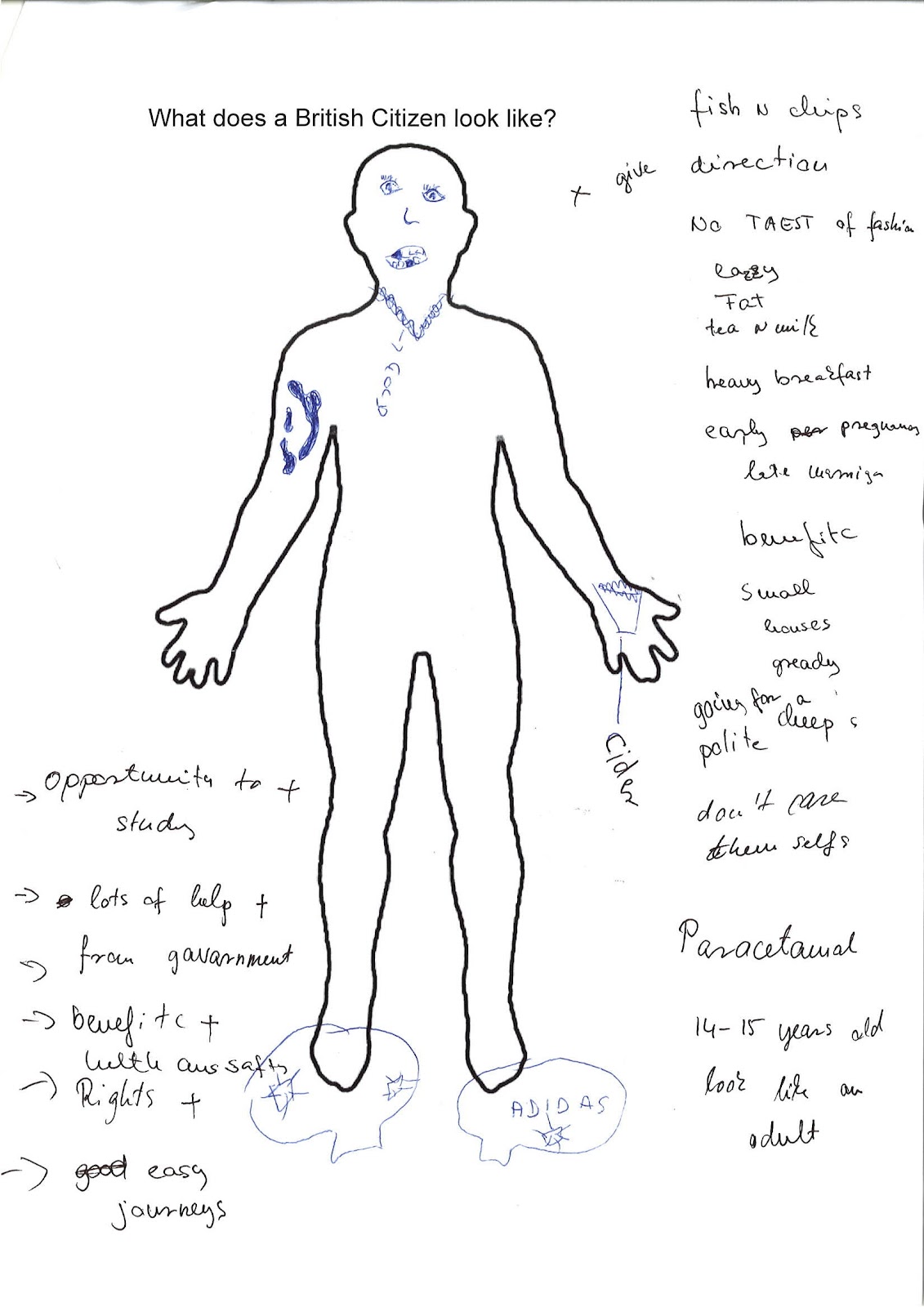
One of my first Citizenship lessons is a discussion about what it means to be a British citizen. This is a very useful exercise, because it means students can discuss stereotypes, habitual behaviour, and differences between life in their own countries and here - linguistically and thematically a very rich seam. I get students into working groups initially to discuss some questions on a worksheet, then lead a whole class feedback. After this, I give groups a sheet. On this sheet is an outline of a human body, and the question, 'What does a British citizen look like?' I then instruct the students to work in their groups and draw what they think a British citizen looks like and write a few phrases.
Now, the whole idea of this is that it's meant to show that British citizens come in all shapes and sizes, that there's no such thing as a 'typical' citizen, that it doesn't matter where you're from, that we are a pluralistic, cosmopolitan society that can rise nobly above crude stereotypes and see The Person Within.

Do you think that is what the students had in mind as well?

Oh dear, no. Instead, most students end up drawing and describing what they think a typical native British person looks like. Here are a few:
OK...not too bad...

well, at least this one's polite...
Hmm - Reading town centre on a friday night


WHAT?

!
As you can see, a bit of a mixed bag, but basically we're tattooed, chip-loving, fag-smoking, beer-swilling, big-breasted, high-heel wearing, lardy-arsed, polite, benefit-scrounging layabouts. Apparently.

Tuesday, 3 July 2012

Getting back in the saddle

Is this wise? trying to get this blog started again with the summer holidays upon us?
Well, I have been neglecting things somewhat, thanks to my lovely, lovely DELTA course, amongst other things. That's the trouble with doing a Dip: you're so busy learning how to be a brilliant teacher that you, er, stop teaching properly, and head back to good ol' Headway, page 76.
Well, the studying is finished for now, although I've been given th go-ahead in my institution to pilot a course based on my module 3 course design - a blended learning course using a Flipped Class Model with TBL in the class-based sessions. I'm experimenting with the online materials at the moment, but unfortunately I'm slightly hindered thanks to our Moodle VLE being updated.
Now, you might think that this flies directly in the face of what I wrote in my last post, but in fact it's a direct development from the principles of using tech that I laid out. This will be a pilot project, which will give me data on the efficacy or otherwise of blended learning. I will initially try it on a limited group of students who have previously been identified as being relatively digitally literate, and on teachers who don't react to computers with gibbering fear. Once I've got some more work done on it, I'll give a fuller report.

Friday, 16 March 2012

Brand New, Shiny New, Shiny Brandy New Tech in class: Worth it?

As some of you may know, I have a twitter feed (@pjgallantry, since you ask), and I follow plenty of my fellow educators through it. I'm also, as some of you may know, a bit of a tech geek - I love brand new shiny gadgets and websites and all sorts of electronic wotsittery. And I have a Vice-Principal in my institution who is eager, excited and and indeed deliriously delighted about all forms of e-learning. Putting all these things together, you would think I'd be happier than a dog with two dicks about being able to combine all the helpful ideas on Twitter, my own techno-enthusiasm, and having the support of a senior admin guy to help my students learn English, wouldn't you?
You couldn't be more wrong.
All I see is a hopeless mishmash of poorly joined-up enthusiasm with little actual thought of what it entails practically and pragmatically.
Let's start with the most fundamental of all - access. Not every student can afford an ipad, or an Android-driven tablet, or even a smartphone. Believe it or not, some students, especially older learners, don't even want a smartphone, or a tablet - and some find using computers difficult. Does this make them losers who don't deserve to learn? Hell it does. If learners are not at least beginning their learning from a level playing field, then neither true learning can occur, nor can the teacher honestly say they are teaching - all they are doing is playing at teaching.
point two: materials. The major publishers have, as we know, taken quite a long time to latch on to how e-materials can be produced. Some more tech-savvy teachers have produced decent materials that work on a variety of platforms, but even so, what is out there is horribly uneven in terms of quality and, pace the first point, accessiblilty. Currently, if any teacher is truly serious about offering equal opportunity of learning to all their learners, they need to have (near-) identical materials available online, as an app, in pdf, as a .doc or equivalent and as a good old bit of paper.
point three: just because we, as educators, get excited about a new piece of tech or a new website or whatever, it does not necesarily follow that a) our students will be equally excited or b) that the brand new shiny thing we have discovered is actually, genuinely useful or game-changing in the class. We might love Twitter or Vimeo or whatever, but unless we consider how pragmatic it is to use it, and how often, it is far too easy to overindulge ourselves to the detriment of learning - but because we're using the new tech or website, we can convince ourselves taht actually we're teaching well, or the students are learning well!
I'd like to suggest a few points that anyone who is getting excited about new tech/software should think about.
1) What does this do that the old method doesn't? If the answer to this is 'nothing' or 'I don't know', then don't use it. Either work out how it is different, or leave well alone. This applies to websites, software and hardware.
2) What does this do better than the old method? Answer as above, really
3) Will my learners benefit from some discovery that excites me? If the answer is 'no', the leave it out of class.
4) Do my learners have access to this online resource I want the class to use? If they don't, then you are the one disadvantaging them. Rethink your approach.
5) Can my students afford this piece of tech? If the answer is 'no', then why are you basing your lesson around it?
One thing I have noticed amid all the excitement over tablet technology - the students I have don't have tablets, but they are quite avid users of smartphones. However, it is glaringly obvious from their use that they see them as accessories to learning rather than necessarily portals for learning - in fact, they browse language sites and apps rather than rely on them. This is an important thing to note, as it means that they have do with language apps on their phones what they naturally do with the other software on it - use it in a casual, relaxed way. If I made them use their phones in a more concentrated 'LEARNING-STYLE' way, they probably wouldn't use them as effectively. Instead of making dedicated learning-rich apps, it might be better to create ones that encourage and support the natural way people browse their phones for information.

Tuesday, 28 February 2012

Now Podcasting!

I've decided to experiment with doing podcasts, and discovering that it's not quite as easy as I thought it might be. For a start, it's incredibly easy to fluff up what you're saying as you record. I was doing 8 or 9 takes before getting it right, so I decided to start scripting what I wanted to say BEFORE saying it. Well, duh!
And then I realised that trying to explain an idea in four minutes or thereabout requires spare, accurate conciseness, and that made me consider how I give explanations in class, especially as it took me ages to think about what I wanted to say, how to say it, and whether my explanation was sufficient enough.

Anyway, here it is: Paul's English Podcasts. Judge for yourself. It is still early days yet, so I'm sure I can get better!

Monday, 23 January 2012

mondaaaaaaaaaaay, part two

Well, the second session went somewhat better. The students had been grumbling about connecting their smart phones to the College wireless network, so I demonstrated how to do it to them - a bit of faffing, but, as it turned out, extremely useful faffing. We were doing a section on holidays and, in particular, city breaks - form filling, asking for information in a tourist information office etc. I then decided to change tack from the rather worthy, but somewhat dull task about to heave into view, and wrote the following up on the board:
          Imagine someone is coming to visit Reading for a couple of days. Where can they stay? What can they do?

We brainstormed a few suggestions, then I told them to whip out their smartphones and research things to do in Reading, places to stay, restaurants etc, organising them into groups of 3/4. They wrote their ideas down on flipchart paper, and, with minimal intervention from me, researched and organised their ideas. They then presented these to the other groups, and the class as a whole voted for the best places to stay, eat in, go to etc.
Good, eh?
It didn't finish there. While they were doing that, I went to Page O Rama, and set up a web page, which I then added to the college intranet for all to gawp it. It isn't finished yet, but the whole lesson finished with a satisfying zing.

mondaaaaaaaaaaay

A very quick inter-lesson posting. My Entry 3 (pre-int/int level ESOL) class are like zombies this morning. There's absolutely no energy whatsoever in the room. It's a shame, as they're normally pretty sparky. However, I have to say that I also feel out of sorts - edgy, a bit worried, somewhat distracted. So the question is, is it me influencing them or them influencing me? Is it just my own perception that's faulty? Or is it just because it's a grey monday in January?

Wednesday, 16 November 2011

Blimey! A post!

Apologies for the long lay-off. A catenation of foul circumstances has hit me, making it difficult to keep my blogs on track at the moment. Since one of these foulnesses is a legal issue, I've felt it better to keep out of sight for the time being.
I'm going to post, as soon as possible, my presentation on Global Englishes and the Language City Paradigm to the English UK Teachers' Conference in November, but it'll take a little time to do the blurb I want to add to it, so I'll leave that for later. I'll also say what I thought about this year's conference, but for now I'll just limit myself to saying that I saw Luke Meddings, looking incredibly grumpy in a duffel coat, heading towards the exit after his presentation.
For today, I just wanted to add an interesting thought about classroom interaction I've just had. Does classroom interaction follow a power law distribution? I read this fascinating article by Alok Jha in The Guardian about it, and it has got me wondering - does the 80/20 law (i.e. 20 % of the participants contribute 80% of the output) also work in 'meaningful' oral exchanges in class?
In theory, of course, it shouldn't. We should expect each and every student to make an equal amount of contribution. In an ideal world, were we to plot every student's contribution, we should expect a graph to exhibit a nearly straight horizontal line, showing equal distribution. However, in reality, I suspect this is not the case. We all know that certain students try to hog all the speaking time and attention, and it is one of the TEFLer's skills in classroom management that curtails this. But when you factor in Teacher Talk Time as well, what happens?
I would anticipate that with a newbie teacher, the Power Law Distribution holds up pretty well as a reliable way of showing the distribution of who contributes most. By the way, I'm limiting myself to oral interactions here, rather than reading and writing, as with these there's far more likely to be an equal distribution of  'meaningful' work. With an experienced teacher, one would expect the distribution of who contributes what to be a much flatter line.
There's only one way to find out however: you'd need to video a series of classes, at different levels, with different instructors, over the course of, say, 150 hours of instruction, or the amount we'd expect students to progress a level in their language comprehension - let's say A2 to B1, as that's a good level to monitor, along with a B2 to C1 control group. You would then need to transcribe and time each and every student's oral interactions as well as every time the teacher speaks, then plot it on a power distribution curve. I bet you get a classic power distribution with new teachers and a flatter line with better classroom managers. I suspect that different methodologies and approaches may also yield different results.
Who'd like to try it?

Labels

Motivation (12) ESOL (11) Methodology (8) Acquisition (7) Learning (7) Portfolios (5) Dip TESOL (4) blended learning (4) dogme (4) EFL (3) FE (3) language citizens (3) language commuters (3) language denizens (3) language tourists (3) learner attitudes (3) linguistic hierarchy (3) marking (3) technology (3) #eltchat (2) English (2) Hierarchy of needs (2) L1 (2) Maslow (2) Natural Approach (2) SATs (2) SLA (2) Silent Way (2) Speaker and listener roles (2) The Language City (2) Turkish (2) VLEs (2) attitudes (2) differentiation (2) elt (2) handling and manipulating (2) iPad (2) language and depression (2) language at intermediate level (2) language city model (2) lesson (2) lesson planning (2) moodle (2) phonology and phonetics (2) smart phones (2) speaking (2) teaching (2) ALTE (1) Arabic (1) CEFR (1) CLL (1) Cadbury's Creme Eggs (1) Classroom activity (1) Communication (1) DTLLS (1) ELT Unplugged (1) ETS (1) French As An Evil Language (1) GLAW profilies (1) Higher level students (1) L1 context (1) Language Interaction (1) Observations (1) P4C (1) Steve Krashen (1) Syllabus (1) TPR (1) actuive vocabulary (1) advice (1) affective filter (1) ambiguous language (1) approaches (1) apps (1) articulator (1) aspect (1) blockbuster (1) boardwork (1) bullying (1) childhood acquisition (1) citizen (1) citizenship (1) city guide (1) classroom techniques (1) cognitive tasks (1) conjunctions (1) copyright (1) creating content (1) curating content (1) diagram (1) digital literacy (1) dimension (1) disruption (1) distance learning (1) e-learning (1) easter (1) encoding (1) english uk (1) examiner (1) experiments (1) failure (1) fossilization (1) future forms (1) grade scales (1) grading (1) grammar (1) group work (1) handedness (1) holistic learning (1) integration (1) interlanguage (1) l2 (1) lesson ideas (1) lexis (1) listening (1) literacy (1) manager (1) meaningful interaction (1) mindfulness (1) mondays (1) neologism (1) online content (1) page o rama (1) passive grammar (1) passive vocabulary (1) podcast (1) politics (1) power law distributions (1) presentation (1) problem solving (1) provider (1) register (1) research (1) resolutions (1) routine (1) sentence structure (1) silent running (1) skills and systems (1) stereotypes (1) style (1) suggestopedia (1) teacher talk time (1) tense (1) tenses (1) total bloody genius (1) tutorial aids (1) tutors (1) twitter (1) using IT (1) validity (1) varieties of English (1) web profiles (1) world englishes (1) writing (1)