It looks like I'm headed for the English UK Teachers' Conference once more, although I have to say it is with somewhat mixed feelings.
Unfortunately, Dave Willis has passed away, and the organisers have asked me to step into the not inconsiderable breach with my own proposal. I'll be talking about Blended Learning and Flipped Classrooms, and in a nod to Dave and Jane, I'm hoping to include something about TBL in a blended learning environment as well.
Monday, 28 October 2013

Monday, 21 October 2013
Full Circle
There were only a few minutes left. I stared at myself in the mirror, trying to gee myself up, but I felt a horrible twisting in my guts. They were waiting for me.
I'd spent the better part of the whole day getting ready, looking at what material I had, and trying to think out my strategies. Several draft plans had ended up scrunched in a bin, and I had gone through a packet and a half of cheap cigarettes. In the end, I thought I'd made something that would get me through. It had a beginning, a middle and an end. It did, or should do, what it said on the tin, as it were. My train of thought hadn't been helped by the fact that I'd been fighting several issues all day. The first was a hangover, caused by watching Galatasaray draw a match with Manchester United the night before, leading to celebrations the size of which I'd never experienced before. The second issue was the noise from the street. I had never really encountered such pervasive, incessant noise pollution before, from gas vans with jingles that sounded like ice cream vans to fishmongers screaming their wares, from insanely loud music in passing cars to streets full of people calling, shouting, selling, announcing. However, I felt, finally, that I was ready.
I picked up my plan and headed off.
As I walked towards my destination, however, I felt my certainty and confidence drain away, leaving nothing but doubt. I arrived, but with half an hour before my fateful assignation, I locked myself in the bathroom, looked at myself, and said out loud,
'What the fuck am I doing here teaching English?'
There was nothing for it however, but to go forth, open the door, and be introduced to fourteen polite, smiling faces. I took a deep breath, and said, loudly,
'Good Morning!'
It was seven in the evening.
And so began my career in TEFL. My first real lesson, on the 21st October, 1993. Here's the page I used:
 Good Old New Cambridge English Course, Book 1, Unit 9c, 'I look like my father'
How I managed to stretch this over an hour and a half of teaching, I have no idea. Yet it has stuck vividly with me, simply because it was that very first lesson. I remember about half the class as well: Mustafa, Umut, Tolga, Cigdem, Esra, Muge, Ibrahim, and Pinar. They were all aged 18-24, so not much younger than me, really.
Since then, I've taught literally thousands of students, and covered virtually everything. My first three years of lesson were mostly at elementary and pre-intermediate level, using the above book and the original Headway series, to the extent that I can still quote large chunks of the tapescripts, complete with the actors' dodgy 'foreign' accents (e.g. 'I live in Tex-ass. That's the secon' biggest state. I got fourteen-fifteen bedrooms...'). I have taught TOEFL prep, and experience I'd rather avoid doing again, thank you very much. Later, I progressed to the dizzy heights of Intermediate level classes, and slowly progressed upwards to do, once I came back to the UK, FCE, CAE and CPE groups, as well as International Foundation Programmes and ESP courses. I've taught EFL and ESOL and the shades in between.
I've been a DOS. I've been Course Leader and Programme Leader. I've been a presenter at conferences, and delivered CPD to colleagues.
And where do I find myself now? After all the cuts to FE spending and funding, after several OFSTED inspections where Leadership and Management have been slated, but nothing has changed, after my team has been butchered to just 2.7 Full Time workers?
I'm teaching an elementary class and a pre-intermediate course. And after years of teaching just high-level students, I've remembered what kept me going in those first couple of years: A student's eyes light up because they'd said something accurately for the VERY first time, or they'd worked out a concept and could apply it straight away, that magical moment of comprehension. You can get it at higher levels, but there's a visceral shiver of excitement from seeing it happen with someone for the first time ever, and use it straight away.
So today, with my Entry 2 (CEFR: A2-B1; EFL equivalent: Elementary) ESOL group, I taught the page above.
It was RUBBISH.
I brought it to a quick end, and carried on with something brilliant instead.

I'd spent the better part of the whole day getting ready, looking at what material I had, and trying to think out my strategies. Several draft plans had ended up scrunched in a bin, and I had gone through a packet and a half of cheap cigarettes. In the end, I thought I'd made something that would get me through. It had a beginning, a middle and an end. It did, or should do, what it said on the tin, as it were. My train of thought hadn't been helped by the fact that I'd been fighting several issues all day. The first was a hangover, caused by watching Galatasaray draw a match with Manchester United the night before, leading to celebrations the size of which I'd never experienced before. The second issue was the noise from the street. I had never really encountered such pervasive, incessant noise pollution before, from gas vans with jingles that sounded like ice cream vans to fishmongers screaming their wares, from insanely loud music in passing cars to streets full of people calling, shouting, selling, announcing. However, I felt, finally, that I was ready.
I picked up my plan and headed off.
 |
| me heading bravely off to face the action. |
As I walked towards my destination, however, I felt my certainty and confidence drain away, leaving nothing but doubt. I arrived, but with half an hour before my fateful assignation, I locked myself in the bathroom, looked at myself, and said out loud,
'What the fuck am I doing here teaching English?'
 |
| Oh well, who wants to live forever! TEEAAACCCHHHHH!!!! |
There was nothing for it however, but to go forth, open the door, and be introduced to fourteen polite, smiling faces. I took a deep breath, and said, loudly,
'Good Morning!'
It was seven in the evening.
And so began my career in TEFL. My first real lesson, on the 21st October, 1993. Here's the page I used:

How I managed to stretch this over an hour and a half of teaching, I have no idea. Yet it has stuck vividly with me, simply because it was that very first lesson. I remember about half the class as well: Mustafa, Umut, Tolga, Cigdem, Esra, Muge, Ibrahim, and Pinar. They were all aged 18-24, so not much younger than me, really.
Since then, I've taught literally thousands of students, and covered virtually everything. My first three years of lesson were mostly at elementary and pre-intermediate level, using the above book and the original Headway series, to the extent that I can still quote large chunks of the tapescripts, complete with the actors' dodgy 'foreign' accents (e.g. 'I live in Tex-ass. That's the secon' biggest state. I got fourteen-fifteen bedrooms...'). I have taught TOEFL prep, and experience I'd rather avoid doing again, thank you very much. Later, I progressed to the dizzy heights of Intermediate level classes, and slowly progressed upwards to do, once I came back to the UK, FCE, CAE and CPE groups, as well as International Foundation Programmes and ESP courses. I've taught EFL and ESOL and the shades in between.
I've been a DOS. I've been Course Leader and Programme Leader. I've been a presenter at conferences, and delivered CPD to colleagues.
And where do I find myself now? After all the cuts to FE spending and funding, after several OFSTED inspections where Leadership and Management have been slated, but nothing has changed, after my team has been butchered to just 2.7 Full Time workers?
I'm teaching an elementary class and a pre-intermediate course. And after years of teaching just high-level students, I've remembered what kept me going in those first couple of years: A student's eyes light up because they'd said something accurately for the VERY first time, or they'd worked out a concept and could apply it straight away, that magical moment of comprehension. You can get it at higher levels, but there's a visceral shiver of excitement from seeing it happen with someone for the first time ever, and use it straight away.
So today, with my Entry 2 (CEFR: A2-B1; EFL equivalent: Elementary) ESOL group, I taught the page above.
It was RUBBISH.
I brought it to a quick end, and carried on with something brilliant instead.
Wednesday, 18 September 2013
Faking it.
Right, now that I'm back into the maelstrom of the new term and put a few lessons under the belt, time to kickstart the old blog again - I hope you all had a good summer, readers.
I don't know about you, but I still feel somewhat apprehensive before going into a new class, even after twenty years before the whiteboard. I still remember my first time going into a class for real, staring in panic at my reflection in the mirror of the bathroom I'd locked myself in, saying 'OhshitohshitohshitwhatthebloodyhellhaveIgotmyselfinto?' and trying to breathe. I just wanted to run away, but knew I couldn't. I would, eventually, have to unlock the door and go into that classroom to be met by twenty pairs of eyes. Minutes passed, and I kept on looking at myself, trying to chide my reflection into action. Suddenly, the school bell, an electronic little jingle that kind of went all wonky at the end, sounded:
Bing bang bing bang bing bang biiioooononinining.
This was it.
What did I do?
I went on to teach for the next twenty years, by striding into the class and saying, as loudly as I could without shouting, 'Good Evening!'
And I've been doing varieties of this with every new class ever since. It was all about faking it at the beginning - the impression of control, the sense of being the boss of the environment, until I actually became so. That may make me sound as if I need to have the class centred around me, and I think in retrospect that was what the first few years of my career was about, but until I learned to master what I do it was where I felt more comfortable. So, I faked it until I became it, which neatly segues into a mention of Amy Cuddy's TED Talk Presentation on that very subject. In it, she talks about how adopting power poses, i.e. postures that imply confidence and dominance, even for as short a time as two minutes, actually change the way a person thinks of themselves, and of how they perform in situations such as interviews. She has conducted experiments that strongly suggest that how we hold ourselves physically strongly feeds into our mental health and general wellbeing, and I'd recommend giving a view.
So, why am I mentioning this? Well, because as a seasoned TEFLer ready to jump on any passing idea as a teaching opportunity, it got me wondering whether I couldn't experiment on this with my own students. The premise: What if adopting 'power poses' would actually improve a student's capacity to learn English? Teaching ESOL students as I do, it struck me that an awful lot of our learners do actually hold themselves in class in rather diminutive, submissive positions - in the role, as it were, of supplicants before the Grail Of Language Learning. In addition, people with their Affective Filters set to Stun tend to adopt highly defensive postures. What if making the learners sit in ways that imply confidence actually changes their attitude and ability, and actually boosts their learning capacity? This would also, incidentally, link into a subject I've discussed here (and at the EUK conference) before, namely Maslovian Hierarchies and Thematically linked language learning.
Well, we'd have to design an experiment to see if it could work, and I think I may have an opportunity to give it a test- but more of that in another post.
I don't know about you, but I still feel somewhat apprehensive before going into a new class, even after twenty years before the whiteboard. I still remember my first time going into a class for real, staring in panic at my reflection in the mirror of the bathroom I'd locked myself in, saying 'OhshitohshitohshitwhatthebloodyhellhaveIgotmyselfinto?' and trying to breathe. I just wanted to run away, but knew I couldn't. I would, eventually, have to unlock the door and go into that classroom to be met by twenty pairs of eyes. Minutes passed, and I kept on looking at myself, trying to chide my reflection into action. Suddenly, the school bell, an electronic little jingle that kind of went all wonky at the end, sounded:
Bing bang bing bang bing bang biiioooononinining.
This was it.
What did I do?
I went on to teach for the next twenty years, by striding into the class and saying, as loudly as I could without shouting, 'Good Evening!'
And I've been doing varieties of this with every new class ever since. It was all about faking it at the beginning - the impression of control, the sense of being the boss of the environment, until I actually became so. That may make me sound as if I need to have the class centred around me, and I think in retrospect that was what the first few years of my career was about, but until I learned to master what I do it was where I felt more comfortable. So, I faked it until I became it, which neatly segues into a mention of Amy Cuddy's TED Talk Presentation on that very subject. In it, she talks about how adopting power poses, i.e. postures that imply confidence and dominance, even for as short a time as two minutes, actually change the way a person thinks of themselves, and of how they perform in situations such as interviews. She has conducted experiments that strongly suggest that how we hold ourselves physically strongly feeds into our mental health and general wellbeing, and I'd recommend giving a view.
So, why am I mentioning this? Well, because as a seasoned TEFLer ready to jump on any passing idea as a teaching opportunity, it got me wondering whether I couldn't experiment on this with my own students. The premise: What if adopting 'power poses' would actually improve a student's capacity to learn English? Teaching ESOL students as I do, it struck me that an awful lot of our learners do actually hold themselves in class in rather diminutive, submissive positions - in the role, as it were, of supplicants before the Grail Of Language Learning. In addition, people with their Affective Filters set to Stun tend to adopt highly defensive postures. What if making the learners sit in ways that imply confidence actually changes their attitude and ability, and actually boosts their learning capacity? This would also, incidentally, link into a subject I've discussed here (and at the EUK conference) before, namely Maslovian Hierarchies and Thematically linked language learning.
Well, we'd have to design an experiment to see if it could work, and I think I may have an opportunity to give it a test- but more of that in another post.
Tuesday, 23 July 2013
Time for a summer blockbuster
Ah, summer...long days away from work, sweltering temperatures outside, cool drinks, time to loaf around and catch up on all that reading you've promised yourself and de-stress from the 9 to 5 (or 9 am to 9 pm in my case on thursdays).
And time to go to the movies and watch something noisy involving explosions and car chases and stuff. There are few guilty pleasures better than a trashy summer blockbuster.
The problem is, I end up with the feeling that I've seen one, I've seen them all.
And do you know, that's probably the case - almost all the big budget action movies are written to a series of simple guidelines.
I read a very interesting article on Blake Snyder and his book Save the Cat! The last book on screenwriting you'll ever need, which outlines 15 points you'll find in your typical successful blockbuster.
Here they are:
And time to go to the movies and watch something noisy involving explosions and car chases and stuff. There are few guilty pleasures better than a trashy summer blockbuster.
The problem is, I end up with the feeling that I've seen one, I've seen them all.
And do you know, that's probably the case - almost all the big budget action movies are written to a series of simple guidelines.
I read a very interesting article on Blake Snyder and his book Save the Cat! The last book on screenwriting you'll ever need, which outlines 15 points you'll find in your typical successful blockbuster.
Here they are:
- Opening image
- Theme is stated
- The set-up
- The catalyst
- Debate
- Break into act II
- B-story
- Fun and games
- Midpoint
- Bad guys close in
- All is lost
- Dark night of the soul
- Break into act III
- Finale
- Final image
Go and watch a blockbuster from the last decade or so, and you should be able to spot all of these moments.
So, why on Earth am I talking about screenwriting guidelines on my ELT Journal blog?
Because it struck me that you could, with a little bit of flexibility, apply these same principles to lesson planning. Certainly the Dark Night of the Soul bit, which usually hits me about three quarters of the way through a lesson on Present Perfect.
I'm not sure about the Bad Guys close in, though. I suppose it could be something like Bad Grammar Appears.
However, the idea of opening and closing images, the statement of aims, the catalyst for action, the B-story and certainly fun and games are all features that we could recognise in any given lesson.
Anyway, just to avoid poaching, I'm patenting, trademarking, copywriting and all-rights-reserving this as The Blockbuster Approach © ™ to ELT.
Because of course what the world needs is another ELT methodology.
Have a very good summer, one and all.
1
Thursday, 30 May 2013
What makes a successful lesson?
I've just been reading 'The Map Is Not The Territory' over on The Secret DOS's blog, which discusses the efficacy (or not) of lesson planning. Speaking as someone with over 20 years' experience of EFL, I can say my relationship to prepping for classes has waxed and waned over time, and involves several variables, including:

- in the early years, not having any experience at all, leading to the creation of exquisitely immaculate lesson plans, taking hours of artisanal labour and minutes of actual lesson time
- the amount of paper available to write down (this was pre-pc) an LP. Several of these were literally created on fag packets.
- being observed/inspected/gang-probed by OFSTED, leading to monumental edifices of LPs
- knowing the materials and class so well that it feels like a waste of time to create an LP
- pretending to be investigating Dogme ELT and saying stuff like, 'Ha! The LP is ANATHEMA to Teaching Unplugged!'
- Hangovers.
I am, of course, writing slightly tongue-in-cheek, he said, slipping in a disclaimer for the benefit of future employers.
However, The Secret DOS's article got me thinking - what does make a successful lesson? We've all had lessons that we've prepared to the finest edge of perfection, but which in class fly in very much the same way that a heavy brick doesn't; Then again, we've gone into a lesson without so much as a really badly-photocopied worksheet in lieu of preparation, and ended up having something incredibly productive.
The trouble is, it's hard to empirically demonstrate exactly what it is that makes a given lesson successful, as there are so many variables.
I thought I'd give it a go, though, using the Power Of A Popplet.
I've had to strip out some variables, such as Will To Live Sapped By The Fact It's Thursday Afternoon, but I've kept the salient ones in. Having said that, I've also probably missed a few as well, but seeing as I started this as a bit of fun, I actually think I've ended up with something useful.
So, tongue now firmly planted in cheek, does this mean we can create an equation for a successful lesson? Let's give it a try:
Ls = Ti{Texp(yt+knCl/knMat) +Lp+Ei+M/TintM} + Si{Skn(knCl/unCl+unInst+knBhvr+knT/Cl)+i(t/cl+mats)+FcX+Sint}>0
where Ls= Lesson Success, and Ti (teacher input) plus Si (Student input) is greater than 0.
Of course, I now expect this equation to appear as gospel truth in the Daily Telegraph.
What do you think? Have I missed anything?
If the Popplet doesn't for some reason appear above, here is the first draft as a pic:

Tuesday, 21 May 2013
ESOL and Digital Literacy in my college
I've been 'attending', if that's the right word, the Virtual Round Table Web Conference this weekend, although I couldn't participate as, such as I would have liked due to other commitments. If you haven't heard of it before, it's an annual conference on language learning and online technology, and how we can integrate the wonderful world of IT ever more deeply into the teaching and learning process. There were some excellent presentations and debates, but if you wanted to start off anywhere, I think I'd have to recommend Gavin Dudeney and Nicky Hockley's presentation on Digital Literacies, an area which is has far wider implications for education than just language learning.
Anyway, it got me thinking about how we use digital literacy and e-learning with our ESOL students, and where we'd like to take it in the future. I thought I'd give a snapshot of the situation in my workplace and what we've experienced/discovered.
We currently use Moodle as our VLE. in previous years, we had Blackboard, then migrated to Moodle a couple of year back. Unfortunately, it was a rather dodgy iteration of the software, and really quite glitchy - things wouldn't save, uploading materials took ages, and there was little attempt at encouraging learners to use it. Where it was used, it was frequently as a repository for word, excel and pdf documents - in other words, as nothing ore than a glorified filing cabinet gathering digital dust. Teachers didn't trust it, didn't understand it, and didn't use it. Combined with a server that was temperamental and a college wireless network that would throw hissy fits at unexpected intervals, and you can understand why it was all a bit unloved.
However, in summer 2012 we installed the latest iteration of Moodle, and I set about experimenting and installing course areas for ESOL. Rather than set up a separate course for each class, I decided to keep it relatively simple, and establish a learning area for each level, e.g. ESOL E1, E2 etc. This meant that the learners (and the teachers) could share materials quite easily and I felt it might foster greater group interaction. We also had a regular 45-minute IT room slot in the teaching schedule for each group, along with an easier way to access Moodle from home, plus an increase in the number of available PCs around the college.
Here are some of the key things that we have found from this setup:
Anyway, it got me thinking about how we use digital literacy and e-learning with our ESOL students, and where we'd like to take it in the future. I thought I'd give a snapshot of the situation in my workplace and what we've experienced/discovered.
We currently use Moodle as our VLE. in previous years, we had Blackboard, then migrated to Moodle a couple of year back. Unfortunately, it was a rather dodgy iteration of the software, and really quite glitchy - things wouldn't save, uploading materials took ages, and there was little attempt at encouraging learners to use it. Where it was used, it was frequently as a repository for word, excel and pdf documents - in other words, as nothing ore than a glorified filing cabinet gathering digital dust. Teachers didn't trust it, didn't understand it, and didn't use it. Combined with a server that was temperamental and a college wireless network that would throw hissy fits at unexpected intervals, and you can understand why it was all a bit unloved.
However, in summer 2012 we installed the latest iteration of Moodle, and I set about experimenting and installing course areas for ESOL. Rather than set up a separate course for each class, I decided to keep it relatively simple, and establish a learning area for each level, e.g. ESOL E1, E2 etc. This meant that the learners (and the teachers) could share materials quite easily and I felt it might foster greater group interaction. We also had a regular 45-minute IT room slot in the teaching schedule for each group, along with an easier way to access Moodle from home, plus an increase in the number of available PCs around the college.
Here are some of the key things that we have found from this setup:
- Probably the single most successful thing on Moodle is the use of forums and chats. Our Entry One learners, for example, are producing work not only more prolifically, but more accurately. Learners' written output has increased by at least 100%, and they are happy to access the VLE from home. The use of fora does vary from class to class, but in many ways this is dependent on the teacher's attitude towards using it.
- The clearer the layout, the more likely the students are to use it. Just like a good coursebook, design is vital to engaging the learners' interest. I've been experimenting with various styles and layouts throughout the year, and the most useful way of getting higher usage rates is by using photos/pictures with hyperlinks to other areas and exercises. It also makes Moodle much easier to use if you're accessing it via tablets/mobiles.
- Some teachers are still frightened that they are going to break the whole Internet by doing something wrong on Moodle. I'm helping to work on that one. Students pick up on teachers' attitudes, and we really have to ensure that the instructors are digitally literate.
- students do want to engage with IT, but sometimes they lack either the equipment, the time, or the knowhow (and sometimes all three) to use it. having the 45-minute slot may seem minimal, but it acts as a vital gateway for our less digitally-literate learners - and some of the teachers, too.
- as learners increase their language knowledge, they engage more with digital literacy. It's striking how the higher the class level, the more likely that students use their mobiles to support learning, for example. This is actually a bit odd - why should your language ability have any impact on how you use IT?
- students are very wary of creating non-written output, e.g. voice recordings or video. To be honest, this may be because the teachers themselves are wary, or worried that they may have to spend inordinate amounts of time helping the learners upload stuff. Something I hope to tackle in the future.
well, that's a few things I've noticed here. As to the future, I'm aiming to create much more of a blended learning experience using Moodle across the board, plus some specialised near-autonomous learning modules in Academic English, and, specifically for ESOL, a Citizenship course. The question remains about how to fully engage both instructors and learners into using IT more efficiently.
Thursday, 16 May 2013
Finding the Right Blend(ed lesson): Creating or Curating the Content?
I've been up to my eyeballs in using Moodle in my college since September, and working out different ways to blend learning from the screen to the classroom. One issue that I find, and I'm sure others do too, is creating my own content for online use. Sometimes, I just want to sit my learners down and give them something that'll work right out of the tin, but when I go Googlewhacking various ELT/ESL sites, I find so much that I get overwhelmed.
The question is this: should we create our content or curate it from a variety of different sources?
On the face of it, creating the content should be what we do - we know our learners, we understand their needs, and we should tailor our materials to fit their requirements. Any teacher with sufficient experience can make things for the class, and make them well. The problem, however, is TIME. When do you have enough of this precious commodity to actually sit down at a keyboard, sketch out your ideas and develop interactive content? Also, there is the issue of the amount of time it takes to create and the amount of time it takes to actually use the resource. I once spent about three hours lovingly crafting something, only to get completely deflated when my learners banged through it in five minutes flat. And if you're not confident with your IT skills, it adds another obstacle to making efficient online content. The other thing to consider is that you want to make content that can be used again and again, not just as a one-off. What's the point of spending an hour making something for five minutes of student interaction?
So what about curating the content? We do this all the time with our classroom materials after all - we get our textbooks and resource books, choose what we feel will be most useful for the learners, and deliver it. Simple. The trouble with online content however, is that a) there is SO MUCH of it and b) a lot of it is poorly-designed, or has weak content, or doesn't actually lead anywhere. There are literally millions of sites that do gap-fills, or have a little video with a little task, or wordsearch puzzles, but I sometimes wonder what the LEARNING point is. You also have to consider how the online content 'fits' into the lesson, or how it can be embedded into your VLE. It's possible to find all the content you need and send it to your learners as a list of links, but from my experience, appealing visual content, delivered in a context-based environment, e.g. in a course page on Moodle, is most effective.
As ever, it's probably best to compromise, at least at the beginning. Creating your own content is time-comsuming, but once it's done, it's done - for good. Here are a few points to consider:
The question is this: should we create our content or curate it from a variety of different sources?
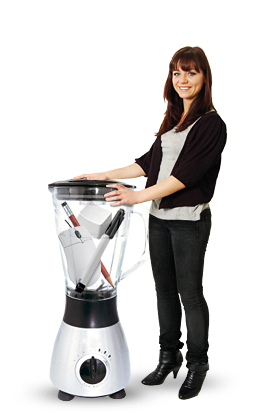 |
| right idea, wrong method? |
 |
| I know I'll find an easy 5-minute exercise in here somewhere.. |
As ever, it's probably best to compromise, at least at the beginning. Creating your own content is time-comsuming, but once it's done, it's done - for good. Here are a few points to consider:
- start off with the scheme of work for the year/term. what content can best be delivered online, and which should stay in class? how do the two types of learning interact with each other?
- which content could be most efficiently created by you for online content? Consider things that you do again and again - for example, certain types of input (for me, this might be explaining a grammar point). Why not film yourself, or convert a Slide Show into a movie format.
- search through online materials carefully. There's no point in reinventing the wheel, and if you find good content, use it - and most of the time, it's free anyway.
- Think how to present the materials - where do they go in the online content? How do they lead into what you do in class? How do they support the learner? Can you grade the work done, or track the learner's progress?
- A very important point - will the learner actually be able to use the content? You have to remember that some students are not that technically savvy, and putting up online work they can't access is the same as them doing nothing at all. We have to consider, in some circumstances, that alongside teaching them the subject, we may also need to teach them IT skills.
However you want to do it, from making your own bespoke course to curating materials from a wide variety of sources, I'd encourage you to experiment as much as possible until you find the right blend for you.
Subscribe to:
Posts (Atom)